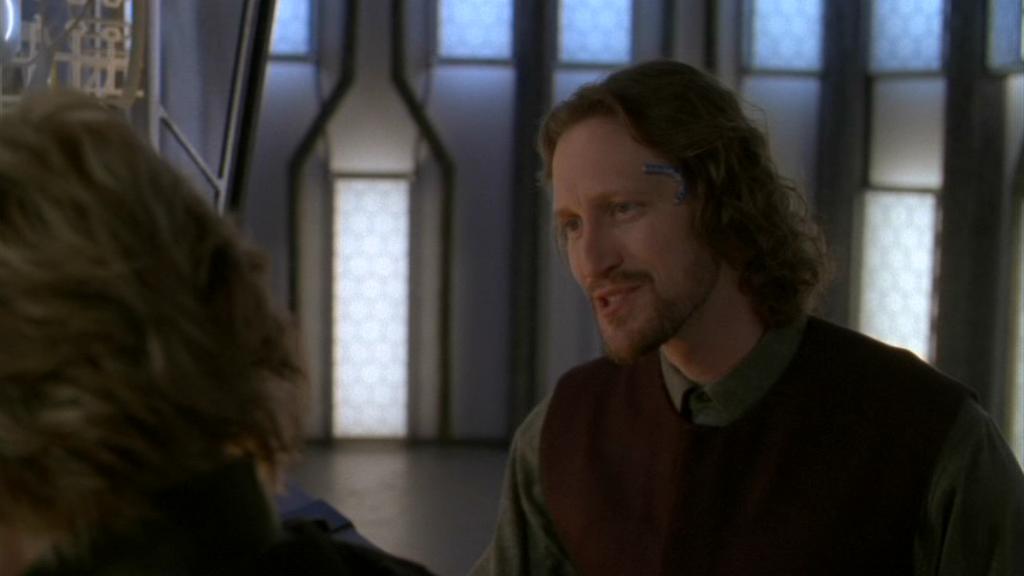
I watch a lot of TV shows on Netflix. I argue that reading is better than movies, that Television is the biggest time waster ever, and that I have better things to do besides play computer games, and yet I go through a new show about every month. Today I am here to defend this practice to the world.
I don't just watch TV shows, I watch scifi TV shows. Star Trek, Stargate, Firefly, Dollhouse, Doctor Who, and Sherlock, to name just a few. My favorite movies are scifi: I, Robot, Tron, Tron: Legacy, Antitrust, etc. I have never seen the Lord of the Rings movies. My fantasy TV picks are limited to Robin Hood and Once Upon A Time. I enjoy very few fantasy films.
I am a writer of both fantasy and science fiction. So how come I prefer to partake of fantasy in written form, but science fiction visually? The first question needs to wait for a future post, the second question is coming up now.
The grand masters of fantasy are Tolkien and Lewis, but also Rowling and Paolini, and dozens of demi-master, and writers of smaller fame but equal quality. The acknowledged grand masters of science fiction are Isaac Asimov and Robert A. Heinlein. I, Robot and 2001: A Space Odyssey are possibly the most well known works of science fiction, with the possible exception of the works of Jules Verne. These writers are fifty years out of date. No one has risen to challenge them. No author has achieved their status, or equaled their work. How hard can it be to trump science fiction so old that we laugh at their future predictions? And yet, when you think of science fiction, what comes to mind? Star Wars. Star Trek. Stargate.
Oh, there's Ender's Game, perhaps, or the works of Jerri Prunelli, but they're still small players compared to the grand scale of the fantasy genre. Face it, in written fiction the science fiction genre nearly doesn't exist. When you do read a science fiction novel you can't expect a fun adventure story of life on a space ship. Science fiction writers wrestle with deep questions like atheism, and life after death. Many science fiction is more fantastical then the highest of high fantasy. Many of them read like a doctorate thesis disguised in a plot.
If an aspiring SF writer wants to learn about things like warp drive, hyperspace, spacial distortions, and other fictional science, where is she to go? To novels like "Revelation Space" where the plot centers around the idea that stars are sentient? To "A Pebble in the Sky" that simply tries to prove that environmentalists are right about radiation from the sun? What if you don't care about the politics of today in relation to what you're writing? What if you want character driven stories with SF elements?
Television doesn't have an agenda. Television can only be profound for a few moments, because then the episode is over and the characters go on. Television has the chance to put a lot of truth into just a few minutes, because they're on a time schedule. Sometimes they skip the meaningful content altogether and just get back to shooting aliens.
From "Firefly" I learned how realistic science fiction can be.
From "Dollhouse" I learned how quickly technology can change.
From "Star Trek" I learned how alien characters can affect the plot.
From "Stargate" I learned a whole lot about physics, and the lack thereof.
From "Star Wars" I learned that a fantasy plot can become scifi with just a few twists.
From "Antitrust" I learned that science fiction doesn't have to be futuristic.
From "Tron" I learned how extraordinary ordinary modern technology can be.
From "Doctor Who" I learned that there's an explanation for everything.
From the written world of science fiction I learned that for a good writer, the sky is the limit.
My current project The Justice Project depends heavily on a lot of complicated telepathic concepts. As a result I've done a lot of heavy thinking on the subject, as it should be written, and while I'm not entirely sure how much of it is helping me, I decided a comprehensive post was in order.
Mind-Speaking
Mind-Speaking is the most basic form of telepathy, and is the one people most commonly associate with the term. You sit there, I sit here, and we talk to each other without moving our lips. Such conversations are typically written like ordinary dialogue, usually in italics.
Dude. I'm trapped in this prison cell, can you still hear me? Yeah, dude, I'm in the one right next to you.
Mind-speaking may or may not be achievable over long distances, depending on the writer, the world, and the rules of the world. Commonly used when communicating with dragons. Examples of books that use mind speaking are Eragon, and The DragonKeeper Chronicles.
Vulcan Mind-Meld
Mind-Reading
Mind-Reading is the next step up, the one usually found in more science fiction type works. There are two forms of mind-reading; the Touch Telepath, and the Intrusive Psychic.
The Touch Telepath requires physical touch in order to communicate with another's mind, and generally must obtain permission of the person who's mental privacy they're invading. There are certain safeguards allowing you to sheild some thoughts from the probing of the mind-reader, such as imagining a closed door. Examples of Touch Telepaths are the Doctor from Doctor Who, Spock from Star Trek: The Original Series, and (in this case a villain) the Wraith from Stargate: Atlantis.
The Intrusive Psychic has advanced mental abilities, and does not usually require any sort of physical contact to invade their victim's mind. The victim may or may not be aware that their mind is being read. The Intrusive Psychic rarely asks permission, and often uses their skills to impress others. Examples of media featuring Intrusive Psychics are Inception, and some episodes of SeaQuest; DSV.
Mind-Control
Mind-Control is one form of telepathy that is universally acknowledged as wrong. Mind-Control is the result of a very powerful mind-reader, often with the aid of advanced technology or magic, taking over the mind of their victim, so that the victim is forced to do whatever the mind-reader tells them. Also a form of hypnosis. They may subtly alter how the mind functions so that the victim will act of their own free will in the interests of the mind-reader.
Memory-Sharing
Memory-Sharing is an extremely powerful means of communication between two telepaths. The memories shared directly can be very strong, sometimes causing identity confusion. The only examples of Memory-Sharing that I've encountered is the fictional series The DarkTrench Saga
Group Memory
Group Memory is a phenomena observed only in telepathic races and cultures. While not yet forming a group mind each individual will have an awareness of their people as a whole, often being able to access memories seen by their ancestors. When a great devestation occurs most members of the race can usually sense it. Examples of telepathic races known to show these aspects are Vulcans (Star Trek), Time Lords (Doctor Who), and Na'vi (Avatar).
Group Minds
Group Minds are a more sinister aspect of being part of a telepathic culture. It is the biological equivalent of linking several ordinary computers together into one, huge supercomputer. Individuals loose a large part of their identity and, in some cases, may loose any sense of individualism at all. The minds function as one unit, with each member acting for the good of all. Examples of group minds are the Borg (Star Trek), the Cybermen (Doctor Who), and the Attic (Dollhouse - maybe be incorrectly categorized).
Other Aspects of Telepathy
Cyberman
Other aspects of telepathy are used in fiction, although, strictly speaking, they're not telepathy as such, but more of general psychic ability.
Matter Manipulation
The telepath who can manipulate matter into other shapes may or may not actually be channeling energy from another source. Also known as transmutation, this skill is fairly rare. It may also include the ability to cast an illusion.
Teleportation
Usually seen as a strictly technical or magical ability, teleportation can be achieved in some instances by telepaths. Usually by simply wishing themselves elsewhere they can succeed in changing their actual location. This is about as plausible as "lifting yourself by the seat of your pants" but by employing other senses such as television, super hearing, and telesmelling a strong enough telepath can move himself and anyone else who happens to be coming along to another location in a method very similar to many teleportation devices with much less trouble and expense. Examples: Harpist in the Wind (Riddle of the Stars).
Networking with Electronics
Often an aspect of being a Cyborg, this may or may not actually qualify as telepathy. The individual who can directly connect to a computer usually does so by means of a neural implant, rather than by more traditional telepathic methods. Yet it could be said that such implants are themselves a means of enabling lesser mind to achieve an aspect of telepathy they might not otherwise possess. Examples include R2D2 (Star Wars), and the DarkTrench Saga.
Shapeshifting
Usually an instinctive ability the individual is born with, shapeshifting can often be obtained by mental discipline. Often adopted by energy beings, it is sometimes seen as the ultimate victory of mind over matter. Examples of shapeshifting (or appearance altering): Riddle of the Stars, and Star Trek. Examples of energy beings: Stargate: SG-1, and The Adventures of Lucky Starr (Isaac Asimov).
As ya'll know, I'm a bit obsessed with Doctor Who. It's influenced me heavily, both as a person and as a writer.
First, let me take a moment to do something very brave, and explain that I am very, very much a pacifist. I cannot justify any war, any where, or for any cause to myself. I don't usually talk about it; it's my own conviction. So it was unusual for me to start a thread on the subject on my favorite fantasy writing forum.
The Doctor is not exactly free from innocent blood. He's responsible for the deaths of millions. He kills when he has to. He's committed genocide multiple times. Almost every episode deals with death is some form. And that is exactly what makes the show so powerful; because he grieves over every single life. Bad guy, good guy, friend or enemy, it doesn't matter. Whether it's thousands who perish as a result of him saving the world, or just a single being he grieves over it. He may not see much, but it never goes unnoticed or unmentioned. Everything comes at a price, and the makers of DW make that price abundantly clear to us.
One night Netflix vanished on me, so I settled down to watch another show you've heard me mention, Stargate. I realized my worldview had changed. Whenever they save the world, there's a price. Shoot and run, leaving a trail of dead enemy soldiers behind you. It never occurred to me to question that before; it's not a deep philosophical show about death. But how many books have you read and how many movies have you watched where random people randomly die for random reasons and no one mentions it again?
No one cares. Even when there are regrets, it tends to be an offhand "For what it's worth, I'm sorry I had to kill him." No one grieves. Not even in real life.
Every day across the sea people die. American troops, yes. Innocents caught in the crossfire. The enemy. We pray for our troops, but is that all you can do? What happened to the sanctity of human life? That any option is better then mass slaughter? Every single human life is sacred. Everyone, guilty or not guilty, saved or unsaved, is a miracle. Every death is a tragedy so great it should never be forgotten.
Starting the thread on this subject led to a three page discussion with views from all over the spectrum, and the end result was a five part series I wrote for the Holy Worlds Blog on the subject of the Sanctity of Human Life. I addressed every topic I'd ever pondered about from torture to suicide and back again. I want my own readers to be able to read these as well, so here are the links to the original articles for your browsing pleasure.
The last episode of Star Trek; the Original Series Season Two was the first episode of a new, spin off series. This was the only episode of that series to air, and no one is quite sure what became of it. Doctor Who fans will assert, however, that Gary Seven was either an impostor or the Seventh Doctor in disguise, for who else could possess the same marvelous technology?
Gary Seven's "Sonic Device."
The Tenth Doctor's Sonic Screwdriver
Gary Seven's manufactured credentials
Psychic Paper
However, there is one difference which we can be quite sure of... at least when it comes to the Tenth Doctor's incarnation. The Doctor is not a cat person.
Turn off your bluetooth! It may be manipulating you.
Stargate: Revisions
SG-1 visits a planet that is uninhabitable except for a small bubble of life. During their stay they notice the bubble shrinking, but the inhabitants have no memory of it being any larger after each shrink. To make matters more suspicious they refuse to remove their ear pieces that tie them into the central network.
Doctor Who: Rise of the Cybermen
Beware of using the same EarBud your neighbor does, they might be connected to a secret network that can control your mind. John Lumic was a brilliant, if a bit off-kilter inventor of cybernetics, including the popular EarBuds used by nearly everyone to directly access a central network. Unfortunately, when Lumic decides that the world would be better of safely encased inside emotionless metal frames he is able to use this network to force everyone with access to comply.
Doctor Who: Sound of Drums
Check your cell phone too. In the Year That Never Was the Master used the Archangel Cell Phone Network to send a message around the world, unseen, creeping into people subconscious. Four drum beats had a hypnotic effect, guaranteeing his election.
I'm sure Doctor Who isn't the only show that has recently reached an astonishing conclusion, before returning to entertain us all next year. But since it's the only show I've actually watched as it was airing it's the only comparison you're going to get.
Season six was season to top all previous seasons. Rumors of the main plot had been growing as far back as season five. Not typically having a plot that reaches across seasons this was somewhat unusual, and had everyone a bit excited. And the plot thickened, until the list of questions that had been asked was long enough that we were constantly forgetting something, and remembering new things, and waiting with bated breath for the finale. And the finale came, with all the brilliance we'd expected of the producer, all questions answered, all loop holes tied up. For not planning in advance it was amazing.
But, days and weeks passed. We talk and talk about the finale, making connections, figuring out complex time loops. And this unsettling feeling grows that there were things that weren't properly addressed. Story arcs that started, and never ended. A host of things that weren't explained to our satisfaction. But it's a TV show. They make it up as they go along. Sometimes things just don't line up, we live with it, and hope they do better next time.
We are born with an innate desire for completion. Whenever we read a book or watch a movie we like everything to be explained at the end. If something is really complex or involved we sometimes wonder how it's even possible for everything to tie together. If it does we admire the writer, if it doesn't we grumble about them. This is most easily seen in mystery stories. So often we get hung up on a particular clue, certain it's the answer, only to find it's only purpose was to mislead us, and what kind of purpose is that?
Let me present to you the most confusing story in the history of long running plots. It's most often referred to as the Holy Bible. Reading through the books of Daniel, of Isaiah, of Revelation it reads almost like gibberish. How can any of it make sense? Many, many interpretations have been made of what it all means, but do any of those take into account every last verse or prophecy? The ones that have been fulfilled are marked by startling accuracy, such as the fall of Jerusalem and the fall of Rome. But who can make sense of the ones yet to come?
We can guess, obsess and speculate. But ultimately we must wait for the finale. No, The Finale. The finale Finale. The end of all things, the beginning of all things. The Finale to end all finales. And do you know what? It's going to be a perfect ending. Every last word of prophecy is going to fit in somewhere. There aren't going to be any loose ends or superfluous remarks. Every last, tiny detail is going to fit into that ending in complexion that we can only stare and wonder at. It's going to be brilliant. It's going to be the most awe-inspiring complete ending that the world will ever see.
Remember that. Every time you see an ending you think was well done or poorly done, it's only our feeble attempt to achieve that Ultimate Finale; the Perfect Ending.
I just got back from an audition today; a Disney audition. I had to be prodded into going, which isn't usual for me. But armed with a monologue from Doctor Who, and Doctor Who audio books to listen too, I drove myself three hours and got through the biggest audition I've ever attended. And every time I felt myself drifting off into the land of exhaustion, boredom, or pessimism I snapped myself back with a persona not quite my own, how would the Doctor react?
Why am I so obsessed with this character that I've started trying to copy him in daily life? Well, he's funny, friendly, happy, outgoing, inspiring, cheerful, intelligent, and generally fun to be around. These are all traits everyone should try to emulate, regardless of where they get inspiration from to do so. We tend to get wrapped up in our own little world, consumed by worry, doubt, and fear.We don't see outside our own little circle to the amazing universe and incredible people beyond. But the Doctor does. So here is your handy list to start you on your way to becoming the Doctor.
1. Smile. A lot. And then smile some more on top of that. Practice your smile, don't let it get rusty and out of shape. Smile at everyone, even if they don't smile back. Especially if they don't smile back. If someone gets annoyed at your smiling, smile bigger.
2. Talk. Whenever you find yourself next to someone, start a conversation. This includes people at the gas station, on the bus next to you, in an audition hall, or in line at the supermarket. Start a conversation by introducing yourself. This helps them to feel like you're not a random stranger, and indicates that you're interested in a real relationship, rather than just making a random comment and moving on.
3. Make eye contact. Guess what? People aren't robots, or cars, or vegetables. Each one is an individual. See them as that, rather than rushing past, trying hard to be invisible. Greet everyone as an individual as much as possible. When you're walking down the street or the grocery aisle make eye contact, smile and nod, as though greeting an old friend. Your smile is wasted if no one sees it.
4. Be helpful. Did someone drop their bag four aisles down from you? Be the first one there to help pick it up! When a child is lost and crying, don't rush past, stop and help. Do you notice trouble going on? Don't stand back like a curious spectator; see if there is something you can do to help sort it out.
5. Don't be afraid to stick out. Dressing different is a good start to a conversation. Wear a funny hat, or a cool shirt, or a crazy scarf. Be original, and exciting and different. But don't be weird for the sake of weirdness, just do it because it's meant to be for you. Not everyone is cut from the same cloth... or wears the same color shoes. Don't think you have to because everyone else does, but don't think you shouldn't just because no one does either!
6. Listen. Talking is good, listening is better. Be outgoing, but be respectful. Notice when something is wrong, and know when to shut up. This takes practice, but it's well worth is. Observe your surroundings, rather than isolating yourself in by hiding behind a book or with earbuds. It is by listening and observing that you can learn how to be the most helpful. Study the people around you, so you can reach out to them effectively.
7. Be bold. Don't be afraid. Don't shrink back because of what people will say about you. Don't be afraid to stick out. Be honest. Admit when you've made a mistake, even to yourself. But forgive yourself for your mistakes and risk trying again. This is the hardest part, not slinking off ashamed the first time someone glares at you, or mocks you for being so atypical. Remember, they're just people. Pick yourself up, put on your biggest, brightest grin, and carry on. Never give up. Never declare it useless.
"When you run with the Doctor, it feels like it'll never end. But however hard you try you can't run forever. Everybody knows that everybody dies and nobody knows it like the Doctor. But I do think that all the skies of all the worlds might just turn dark if he ever, for one moment, accepts it."
"How long have I known you?"
"All my life."
"Then why won't you tell me where we're going?"
"You won't like it."
Sidekicks are the voice of reason when the main characters are caught up in the quest. They're also the eyes that see the unexpected coming when the heroes are involved in a more important duels. Listen to them.
"Why didn't you tell me?"
"I did. You weren't listening."
After all, what are sidekicks for if not watching out for the main character? If you have a tag-a-long you might as well make use of it, and if you have an adviser, well:
"I'm your Councilor! I'm supposed to support you!"
A young woman exits the elevator and inquires of a random character walking past: "I think I'm lost. I'm looking for ward 26?"
Who replies: "This way, Rose Tyler."
A young man falls unconscious and awakens next to a mysterious man's fire. They talk for a considerable time and the stranger (who has not been introduced) calls him by name: "Artose, God has a plan for your life."
If a complete stranger knows your name it is a very good indication a villain is behind it. (Either that or he's a angel or you're having a vision; everyone in dreams knows who you are.) You should never, ever walk off with someone who knows your name when you never gave it.
How do you know my name? Are you an angel, a saint, or a devil?
How do you know my name? Where you expecting me?
How do you know my name? Who sent you? Where's my companion? Where are you taking me?
Unless you're wearing a nametag, or you have your identity printed on your forehead, or you're in a dream, or you know the person you're speaking to, or the person knows a person you know and can identify him, or you have an ID that's scanable from the distance if a strange knows your name... don't go with him. If a stranger knows your name... ask him how. And if he doesn't answer satisfactorily do the smart thing.
Last month I went to the county fair along with some of my brothers and sisters. In less than an hour I was wondering why I had come. I'd already been on all of the sane rides twice, and managed to get tricked onto one of the insane rides and was sorely wishing I had just stayed at home and read a good book instead. I don't like the rides that people go on for thrills and this being the country fair and all the thoughts that run through my mind are all the people that would die if the thing broke, and the likelihood of it breaking, and the fact that if the maintainers are anything like the ride operators I wouldn't want to trust my life to their hands... The only thing that kept me sane on one particular trip was the thought that there was no way I had lived this long only to die on a malfunctioning ride at the county fair. If I was going to die young it would be in a car accident or something else normal, not in a freakish accident at the hands of a stupid operator.
I had wanted to go though, and my siblings had bought my ticket for me, so I had to enjoy myself somehow. We got there at about 6:00 and the fair didn't close until 10:00 and I was at my wits end what to do. I rambled at my sister, who was in the unusual position of being forced to listen to me ramble while we were standing in line for one of my favorite rides. (It didn't leave the ground.) I explained which rides I liked and why I liked them and I analyzed my reasons for liking them and came up with the following premise:
I like kid rides. I like rides that you go on with a kid and you wave your arms about and scream and get them to stare at you and ask why you're screaming. I like making up stories about the adventures that the rides represent and having a kid to tell those stories too. I like having someone to make a fool of myself too. I wasn't having any fun that day because it was the older kid's night out and there was no child for me to interact with.
"You could always come with me."
Like taking the Doctor and sticking him in a room full of stuffy Time Lords.
"We have the privilege of viewing all of time and space." We have the privilege of the freedom of the world. We have the authority, the cars, and the money to buy tickets and go to the fair. We're adults; we're mature, responsible, and stuck with the dull drudgery of running the world. We envy the children we once were running carefree with their games. They envy us our lack of school, the freedom that they see our lives. By sharing our lives with theirs we can recapture the innocence of childhood and teach them the responsibilities of adults. Only in the presence of a child can I stop behaving as an adult.
"I can't see it anymore. You make all of time and space your backyard, and that's what you have. A backyard. But you... you can see it. And when you see it, I see it."
In front of us in line two eager excited girls were informed that they couldn't go on the ride without an adult. They ran over to their mom, but she wasn't interested in riding and told them they'd have to find another one to go on. I stepped out of line and told the mom that if it was all right with her they could ride with me. I was an adult; and for one shining moment I was the Doctor.
I could fix things, I could help children. I can enjoy the universe by showing it to others, as I enjoyed myself on that ride with two strangers. My brother and his friends were "too cool" to hang out with me, but I didn't mind them any more. I didn't get another Doctor moment that night, but I kept my eyes open.
The Doctor isn't just a character from a British TV show. He's a concept and an ideal. He's the child inside every one of us begging to be expressed, and that's why so many people associate themselves with him. You can be the Doctor and share the glorious parts of life with every one of your companions.
It's never been alive on your world before. It never occurred to you to check and see if it wasn't exactly the same as it's counterpart. Why would you ask the ground if it minds being stepped on? Why would you question your right to eat a tomato? And yet, this is scifi, and you never know.
Today's parallel episodes are Watergate from Stargate; SG-1, and 42 from Doctor Who. Before I proceed any further I simply must point out the interesting coincidence that both episode titles rhyme with the show title. Try it. "Watergate - Stargate, 42 - Doctor Who." Fascinating.
42
The TARDIS is thrown off course in response to a distress signal and ends up somewhere in the farthest parts of a cargo ship. Turns out the cargo ship is a sort of illegal fuel harvester, the engines have been sabotaged, and they're heading straight for a nearby sun. The title comes from the fact that they have only 42 minutes before impact with the sun.
Well, around 32 minutes into this the Doctor has to go outside the space ship and comes back in genuinely terrified. The ship had been harvesting hydrogen from the sun, but guess what? The sun was alive. It's a life form, and they'd hurt it, and it wanted vengeance. Cue all kinds of terrible things to happen for the remaining 12 minutes of the show.
Watergate
The Americans are always our heroes, and they just aren't quite stupid enough for this to happen to them, so suddenly the Russians have a Stargate of their own! And of course, they're the Russians, and they don't know anything, so they call in SG-1 to help them when their gate gets stuck open. They'd found a world that's completely underwater and had build a submarine to explore it, and had brought back a sample of the water for analysis.
When SG-1 arrives on the scene the sample has gone missing and everyone in the base is dead. So they take the sub and go to explore the world to find out why the gate won't close. They get very stuck. Because guess what? The water is alive. The Russians took a sample away, but it's a life form and they hurt it. It wants the sample back, and it holds the sub as hostage until it's returned.
The Parallel: Is it also a coincidence that they deal with Fire and Water? So, in both episodes we had a large, usually non-sentient life form that had part of it taken away and wanted it back. In both there are lives at stake, and in both it happened through an act of stupidity on the part of people who aren't main characters.
What did we learn from these two episodes? Always scan for life before taking anything away from a large usually non-sentient body. As for which one I liked better, it would have to be 42. Because Doctor Who is awesome that way. And a raging sun is a lot more terrifying than relentlessly crushing water.
"That's what I see. All the time.
And doesn't it drive you mad?"
"It's like when you're a kid, the first time they tell you that the earth's turning and you just can't quite believe it because everything looks like its standing still. I can feel it. The turn of the earth. The ground beneath our feet spinning a thousand miles an hour. And the entire planet is hurtling around the sun at sixty-seven thousand miles an hour. And I can feel it. We're falling through space, you and me, clinging to the skin of this tiny little world and if we let go... That's who I am."
A few weeks ago I was attempting to explain time loops and time paradoxes and time-space continuums to a friend of time. Her reaction was to get increasingly dizzy as I expounded upon fixed and flux time, and how something could be everywhere and everytime.
"You are tiny. I can see the whole of time and space; every single atom of your existence. I can see everything. All that is... or was... or that ever could be."
I explained about the time-space vortex, and how it was everywhere, not in just one location. Time is like a sphere, and we are tiny threads running over it. And I tried to give examples of how something affects all of space-time, not just one part. Not just one time period, or one location. It's more than being everywhere at once, it's being everytime at once. Literally everywhere, all encompassing. No beginning or end. It doesn't exist in time for it is time. Then I was struck by a sudden thought.
"And the Word became flesh
and dwelt among us."
That's what Eternity is. It's not a measurement of time... it is time. It's all of time. It's past, present and future. When the bible talks about being with Christ for Eternity it doesn't just mean for the rest of time. It's not from here on out. It's here, and always. We're not just with him for forever, we always have been. From the beginning, to the end, and back again. We were never without him. It's Eternity, Forever, and with everything. Every moment in history, every part of time and space, outside it and beyond... so completely, utterly, and totally encompassing, beyond any restrictions or dimensions that logic or rationality can explain. And that's dizzying, eh?
"In the beginning was the Word, and the Word was with God, and the Word was God and the same was in the beginning with God. All things were made by him; and without him was not any thing made that was made. In him was life; and the life was the light of men. And the light shineth in darkness; and the darkness comprehended it not."
If dreaming is an awesome way to gather ideas, then sleeping is the perfect way to loose them. How many times have you woken up from a dream, or been unable to sleep, or woke up for no reason, and had an Awesome Idea, and if you didn't write it down immediately, you forgot it by morning?
Last night I stayed up far too late watching TV shows. I had enough time before bed to watch three 45 min. episodes, but both turned out to be two parts, resulting in watching 4, successfully keeping me up an hour late. Finally making my way into my warm, cozy bed I proceeded to stare at the ceiling, realizing I was suddenly alert. I couldn't sleep. And when I can't sleep, I start thinking. So I thought, and I thought about the show I'd just seen, and I made connections and drew lines and speculated, and I finally ended up connecting two of my favorite doctors in all of film and television: Doctor Who and Doctor Horrible.
Doctor Horrible is the title character of a 45 minute web musical Doctor Horrible's Sing-a-long Blog. From the minute I heard the first notes of the first song I knew I had found something remarkable and unique. Wikipedia classifies it as "a musical tragicomedy miniseries in three acts, produced exclusively for Internet distribution." The word that jumps out at me most is the term "Tragicomedy." I'd never heard of such a thing before, but it seems to oddly fit the structure and style of the musical.
Doctor Horrible is an anti-villain, a villainous protagonist, a heroic antagonist. He's a walking contradiction. The only thing more backwards from your typical hero setup is the arrogant, licentious, and selfish hero; Captain Hammer. Everything Doctor Horrible does is funny, from his inability to make his super-weapons work to the fact that he keep a vlog, and sings on it. We laugh when he gets threatened by Captain Hammer; we laugh when he disguises himself as a bush to spy on the girl he loves.
A good book will have the power to make it's readers both cry and laugh. To acheive both those goals within the covers of a novel is a must. To do it within a single chapter is remarkable. But how do you get your audience to cry and laugh, both at once? Within the same song? TV Tropes defines the first law of Tragicomedies as "In any work that has both drama and comedy, the drama will rise proportionally with the level of tension in the story. The comedy will do the reverse." This means that it will start out comedy, and end up drama or tragedy, gradually morphing as the story progresses. Perhaps this is why I didn't recognize the cross-genre, for Doctor Horrible does not follow this rule.
Christopher Eccleston as the Ninth Doctor.
The Doctor of Doctor Who is nine hundred years old. He's a hero who saves the world, many world in fact, on a regular basis. This sounds like fun, lots of characters do this. But think about saving the world. In order for the world to be saved, it has to be lost first. Saving the human race is a noble and awesome thing, but what seems to set the Doctor so much apart is that even in his moment of triumph he doesn't forget what was lost in the regaining. You don't live for nine centuries and not learn something of pain and loss. He suffers, and we all know that suffering characters are the most endearing. But at the same time the series is horribly funny. Between a time machine disguised as a phone box, a sonic screwdriver, and the endless jokes about his name it's one of the funniest shows I've seen. Most episodes seem to be divided into funny and dramatic, but a few are on the level of Doctor Horrible, thrusting the two back to back, and alternating so fast you can barely keep up.
Doctor Horrible doesn't loose it's comedic feel when the action climaxes and the drama is overwhelming. The second to last musical number is eery, sarcastic, and hopeless, as Doctor Horrible prepares to finish off his nemesis. We get a real explanation of his world view, and why he became a super-villain, and it's more bitter because it tastes of the truth. It's a poignant moment and in the middle of it he stops to correct the spelling of his name for a journalist, and we laugh again, not quite able to break the tension of that moment.Pain is more real because of the laughter, and laughter has more meaning in context of the drama.
Doctor Who, Season One, Episode 10 - The Doctor Dances. This is one of the funniest episodes I've seen. Highly quotable, with lots of jokes about sonic screwdrivers and dancing. It's also one of the most dramatic. It's a classic comedy while we're running for our lives while arguing about inconsequential things, but there's nothing inconsequential about the ending, when the Doctor realizes it can all be fixed, it can all be fixed: "Just this once, just one day like this... everybody lives, Rose! Just this once, Everybody lives!"
Everyone gets to live! How many heroes get that opportunity? How many times can the world be saved from certain disaster with no casualties? And how many stereo-typed characters would care, would be so elated over every single life? Just the fact that he recognizes that makes us want to weep for all the times when it wasn't possible. It's horribly, tragically, wonderful. It's brilliant. It's the kind of characters you don't find every day, and that I can only hope I'll someday know how to write. It's the kind of stories that I want to watch over and over again, that I want to quote, that I wish I could act it.
Tragicomedy is an underutilized genre. Those few things that fall into it's category are often lame, and do not live up to the promise it presents. Life is a tragicomedy; laughing through our tears, and weeping for joy. It is the genre I wish to write, and the genre I'd love to read.