Showing posts with label telepathy. Show all posts

Thursday, March 29, 2012

Telepathy: Like the gods...

One of the comments on one of my telepathy articles indicated I had missed something. At first I didn't think I had, but then I realized that the commenter was right.

I'd say that under "Mind reading" There is a phase between Touch Telepath and Intrusive Psychics. This is the telepath whose ability is a passive one. He/she is bombarded by the thoughts of others rather than reaching out and grabbing them, and has to learn to filter all the voices in their heads out. Most telepaths in Marvel Comics are of this variety (e.g. Professor Xavier, Jean Grey). Now granted, most of them have the ability to be intrusive psychics and reach into others' minds, but I've seen some examples (though none immediately come to mind) of those whose abilities are nothing more than hearing the surface thoughts of those around them without even trying.
There are three types of telepathy. Involuntary, controlled, and physical. I already covered that last one when I discussed touch-telepaths, so this article deals with the difference between controlled and involuntary telepathy.

I have enough doubt in my abilities without having to listen to Riker and Picard's as well!
Involuntary telepathy is not fun. Most people cursed with such an ability cannot handle the stress, and meet with a tragic end at a fairly young age. (If they're born with the ability, that is. If it's something they suddenly obtain than they meet a tragic end even faster at whatever age they're currently at.) Either that, or they lose the ability, a relief to everyone involved.

The involuntary telepathy hears the thoughts of everyone around him. It can be compared to being in a room with every radio station available playing at once, and being unable to stop your ears, or turn any of them off. The minutes someone walks into the telepath's range they can hear their thoughts, and sense their feelings. They can't tune it out, or filter it, and it affects them deeply on a personal level. This ability is frustrating, exhausting, and it can be impossible for someone who possesses it to lead a normal life.

The controlled telepath has all the abilities of the miserable young person, except that he can control it. He can shield himself from other's emotions, or block out their thoughts at will. He can function perfectly normally, and conceal his ability as needed. Yet he can also, instantly and without effort, pry into anyone's thoughts without their being aware. Because of his mental shielding he's mentally stable, and can think like a normal human being. He can control the radio stations, filter them, listen to them individually, or shut them out altogether. He doesn't have to get emotionally involved with everyone who's thoughts he reads; he can remain independent.

The controlled telepath has all the makings of a villain... or a god.

Power has to come at a price. Power without penalty is what makes characters godlike, and removes any sort of struggle or conflict. It's easy to sympathize with a telepath who would virtually give up his life for five minutes of silence. It's infinitely harder to feel any sort of concern for a telepath who could take over the world with relative ease if the fancy struck him. Even though their abilities are basically the same the effect on the characters is infinitely different.

Touch telepaths are not all-powerful and invulnerable, because they're restricted to physical contact. Even if it doesn't require a great deal of training, it usually requires a great deal of concentration, and most of the time once a link is established information can be exchanged both ways. It is also fairly easy to conceal specific information from inquiring minds. A touch telepath is forced to become personally involved with the person who's mind is being read, and I can only imagine how complicated it would be to forcibly interrogate an unwilling victim. 

Thursday, March 22, 2012

Pandora: A Telepathic Planet

It came to my attention that many people do not understand the James Cameron movie Avatar. They see "New Age" they see people without clothes on, they see cliche plots, and overdone special effects. And somehow they manage to miss the immense potential of the film; the enormous brilliance of the premise. I am here to clear up this mass confusion, and to reveal Pandora and the Na'vi for what they really are; the organic version of Tron.

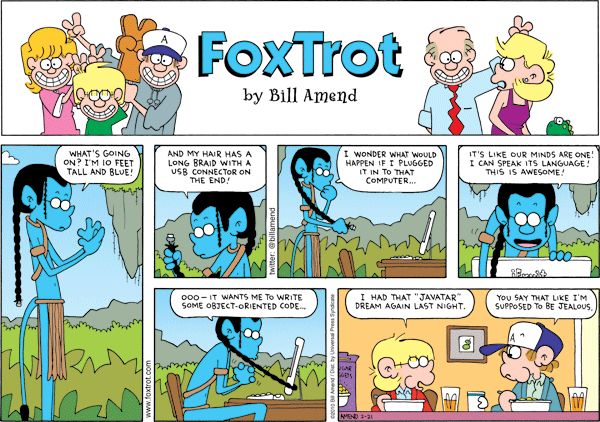
I'll start with a very simple concept, one I'm sure you all can understand. A comic strip.


This is, actually, a surprisingly accurate representation of the Na'vi. Since you're reading this I assume you have a computer, and if you have a computer you're probably aware of what a USB is. Just in case you aren't, USB is how various devices are connected to each other. You use a USB cable to connect your MP3 player to your computer to transfer music. You use it to download pictures off your phone. It can be used for recharging, and for data exchanges.

Well, the Na'vi have the equivalent form of connection in the neural connectors at the base of their skull. Animals have two each, right behind the ears. When the ends of these fibre optic type connectors are laid together they connect, allowing information to pass from one mind to the other, much like data along a USB cable.

Cool, huh? But it gets better. The trees are connected neurally through the roots, so the entire forest is in communication with each other, spreading information around. The mistake the Na'vi made was worshiping the earth as a goddess, Eywa, when in reality it's just a huge data bank. One of the characters describes it thus:

What we think we know - is that there's some kind of electrochemical communication between the roots of the trees. Like the synapses between neurons. Each tree has ten to the fourth connections to the trees around it, and there are ten to the twelfth trees on Pandora... That's more connections than the human brain. It's a network - a global network. And the Na'vi can access it - they can upload and download data - memories - at sites like the one you just destroyed.
So, in other words, the entire planet is like a hard drive. And trees like the one pictured below are USB ports. And through the neural connectors coming out of their heads the Na'vi can "plug-in" and access the memory. They can store memories there, experiences, knowledge; for future generations to access and learn from.


Even the rituals they engage in, holding hands and singing around such a location fit in. They're forming a giant processor. Individually they're weak, but together, all striving for the same thing, they become very, very strong. There's really nothing religious about it all. And what they could do if they understood; imagine the potential for that kind of information sharing. They'd never need to develop technology; because they are the technology. The concept is mind blowing. The potential is staggering.

 Now can you see Avatar in a new, scientific, light?

Wednesday, February 29, 2012

Telepathy

My current project The Justice Project depends heavily on a lot of complicated telepathic concepts. As a result I've done a lot of heavy thinking on the subject, as it should be written, and while I'm not entirely sure how much of it is helping me, I decided a comprehensive post was in order.

Mind-Speaking
Mind-Speaking is the most basic form of telepathy, and is the one people most commonly associate with the term. You sit there, I sit here, and we talk to each other without moving our lips. Such conversations are typically written like ordinary dialogue, usually in italics.

Dude. I'm trapped in this prison cell, can you still hear me?
Yeah, dude, I'm in the one right next to you. 


Mind-speaking may or may not be achievable over long distances, depending on the writer, the world, and the rules of the world. Commonly used when communicating with dragons. Examples of books that use mind speaking are Eragon, and The DragonKeeper Chronicles.

Vulcan Mind-Meld
Mind-Reading
Mind-Reading is the next step up, the one usually found in more science fiction type works. There are two forms of mind-reading; the Touch Telepath, and the Intrusive Psychic.

The Touch Telepath requires physical touch in order to communicate with another's mind, and generally must obtain permission of the person who's mental privacy they're invading. There are certain safeguards allowing you to sheild some thoughts from the probing of the mind-reader, such as imagining a closed door. Examples of Touch Telepaths are the Doctor from Doctor Who, Spock from Star Trek: The Original Series, and (in this case a villain) the Wraith from Stargate: Atlantis.

The Intrusive Psychic has advanced mental abilities, and does not usually require any sort of physical contact to invade their victim's mind. The victim may or may not be aware that their mind is being read. The Intrusive Psychic rarely asks permission, and often uses their skills to impress others. Examples of media featuring Intrusive Psychics are Inception, and some episodes of SeaQuest; DSV.

Mind-Control
Mind-Control is one form of telepathy that is universally acknowledged as wrong. Mind-Control is the result of a very powerful mind-reader, often with the aid of advanced technology or magic, taking over the mind of their victim, so that the victim is forced to do whatever the mind-reader tells them. Also a form of hypnosis. They may subtly alter how the mind functions so that the victim will act of their own free will in the interests of the mind-reader.

Memory-Sharing
Memory-Sharing is an extremely powerful means of communication between two telepaths. The memories shared directly can be very strong, sometimes causing identity confusion. The only examples of Memory-Sharing that I've encountered is the fictional series The DarkTrench Saga

Group Memory
Group Memory is a phenomena observed only in telepathic races and cultures. While not yet forming a group mind each individual will have an awareness of their people as a whole, often being able to access memories seen by their ancestors. When a great devestation occurs most members of the race can usually sense it. Examples of telepathic races known to show these aspects are Vulcans (Star Trek), Time Lords (Doctor Who), and Na'vi (Avatar).

Group Minds
Group Minds are a more sinister aspect of being part of a telepathic culture. It is the biological equivalent of linking several ordinary computers together into one, huge supercomputer. Individuals loose a large part of their identity and, in some cases, may loose any sense of individualism at all. The minds function as one unit, with each member acting for the good of all. Examples of group minds are the Borg (Star Trek), the Cybermen (Doctor Who), and the Attic (Dollhouse - maybe be incorrectly categorized).

Other Aspects of Telepathy

Cyberman
Other aspects of telepathy are used in fiction, although, strictly speaking, they're not telepathy as such, but more of general psychic ability.

Matter Manipulation
The telepath who can manipulate matter into other shapes may or may not actually be channeling energy from another source. Also known as transmutation, this skill is fairly rare. It may also include the ability to cast an illusion.

Teleportation
Usually seen as a strictly technical or magical ability, teleportation can be achieved in some instances by telepaths. Usually by simply wishing themselves elsewhere they can succeed in changing their actual location. This is about as plausible as "lifting yourself by the seat of your pants" but by employing other senses such as television, super hearing, and telesmelling a strong enough telepath can move himself and anyone else who happens to be coming along to another location in a method very similar to many teleportation devices with much less trouble and expense. Examples: Harpist in the Wind (Riddle of the Stars).

Networking with Electronics
Often an aspect of being a Cyborg, this may or may not actually qualify as telepathy. The individual who can directly connect to a computer usually does so by means of a neural implant, rather than by more traditional telepathic methods. Yet it could be said that such implants are themselves a means of enabling lesser mind to achieve an aspect of telepathy they might not otherwise possess. Examples include R2D2 (Star Wars), and the DarkTrench Saga.

Shapeshifting
Usually an instinctive ability the individual is born with, shapeshifting can often be obtained by mental discipline. Often adopted by energy beings, it is sometimes seen as the ultimate victory of mind over matter. Examples of shapeshifting (or appearance altering): Riddle of the Stars, and Star Trek. Examples of energy beings: Stargate: SG-1, and The Adventures of Lucky Starr (Isaac Asimov).