The Idea Factory is moving! After a great deal of pressure from those more geeky than I am I have decided to abandon Blogger and switch to wordpress, obtaining my own URL in the process. I haven't trusted Blogger since the day this blog started; after all, it ate the entire thing the day after it was created!
We are moving to katielynndaniels.com This was previously a website for my musical pursuits, but we've moved that site over to music.katielynndaniels.com. There are now two websites; one for writing endeavors, and one for music. To recap:
But that's not even the really big news. The really big news is this:
The Tale of Pirate Shishkabob is finished, and ready for sale!
That's right, it's all done. You can now order your very own copy of this infamous pirate's tale! To celebrate the final release I'm making a special offer: get your order in before May 13 and your copy will be signed by both the author(me!) and the illustrator. Do keep in mind that these copies will not ship for at least a week after the deadline closes, so if you want your copy in a hurry you can order it straight off of Amazon.Check out the official page for more details.
Also, have you seen the shiny new facebook page?
That's not the end of the exciting news. "The Sword and Pen; the Poetry of Holy Worlds" is also finally available for sale. I have several pieces in the collection, wrote the introduction, and was one of the organizers. All proceeds go back to the forum.
One of the comments on one of my telepathy articles indicated I had missed something. At first I didn't think I had, but then I realized that the commenter was right.
I'd say that under "Mind reading" There is a phase between Touch Telepath and Intrusive Psychics. This is the telepath whose ability is a passive one. He/she is bombarded by the thoughts of others rather than reaching out and grabbing them, and has to learn to filter all the voices in their heads out. Most telepaths in Marvel Comics are of this variety (e.g. Professor Xavier, Jean Grey). Now granted, most of them have the ability to be intrusive psychics and reach into others' minds, but I've seen some examples (though none immediately come to mind) of those whose abilities are nothing more than hearing the surface thoughts of those around them without even trying.
There are three types of telepathy. Involuntary, controlled, and physical. I already covered that last one when I discussed touch-telepaths, so this article deals with the difference between controlled and involuntary telepathy.
I have enough doubt in my abilities without having to listen to Riker and Picard's as well!
Involuntary telepathy is not fun. Most people cursed with such an ability cannot handle the stress, and meet with a tragic end at a fairly young age. (If they're born with the ability, that is. If it's something they suddenly obtain than they meet a tragic end even faster at whatever age they're currently at.) Either that, or they lose the ability, a relief to everyone involved.
The involuntary telepathy hears the thoughts of everyone around him. It can be compared to being in a room with every radio station available playing at once, and being unable to stop your ears, or turn any of them off. The minutes someone walks into the telepath's range they can hear their thoughts, and sense their feelings. They can't tune it out, or filter it, and it affects them deeply on a personal level. This ability is frustrating, exhausting, and it can be impossible for someone who possesses it to lead a normal life.
The controlled telepath has all the abilities of the miserable young person, except that he can control it. He can shield himself from other's emotions, or block out their thoughts at will. He can function perfectly normally, and conceal his ability as needed. Yet he can also, instantly and without effort, pry into anyone's thoughts without their being aware. Because of his mental shielding he's mentally stable, and can think like a normal human being. He can control the radio stations, filter them, listen to them individually, or shut them out altogether. He doesn't have to get emotionally involved with everyone who's thoughts he reads; he can remain independent.
The controlled telepath has all the makings of a villain... or a god.
Power has to come at a price. Power without penalty is what makes characters godlike, and removes any sort of struggle or conflict. It's easy to sympathize with a telepath who would virtually give up his life for five minutes of silence. It's infinitely harder to feel any sort of concern for a telepath who could take over the world with relative ease if the fancy struck him. Even though their abilities are basically the same the effect on the characters is infinitely different.
Touch telepaths are not all-powerful and invulnerable, because they're restricted to physical contact. Even if it doesn't require a great deal of training, it usually requires a great deal of concentration, and most of the time once a link is established information can be exchanged both ways. It is also fairly easy to conceal specific information from inquiring minds. A touch telepath is forced to become personally involved with the person who's mind is being read, and I can only imagine how complicated it would be to forcibly interrogate an unwilling victim.
Evanescence is the band no one would guess I listen to. It's the "Find the one that's different" in my music collection. As a general rule I don't listen to that style of music, and the first two times I heard their songs I was totally not interested. No, what brought me around was the lyrics. Song lyrics in a friend's chat status that so completely impressed me I had to hear the song.
You don't remember me, but I remember you.
I lie awake at night and try so hard not to think of you.
But who can decide what they dream? and dream I do. - Taking Over Me
The song starts with piano, effectively catching me off guard with the drums and electric guitar that start mere seconds later. But by then I'm already trapped... her use of minor, chord changes, and harmonies is a feast for the ears. In fact, often the rock elements add to the song, rather than get in the way by being distracting. And, of course, Amy's voice is gorgeous.
I was thoroughly snared when I heard the song "My Immortal." The version I heard had no drums or electric guitar at all, putting it in the class of songs I usually listen to, and allowing me to become completely captivated without having to subject myself something I usually didn't like at all. In fact, I loved this song so much that I later went on to do a harp cover, successfully imitating the piano part through most of the song. It's the most accurate reproduction of a song I've ever done. There was nothing I wanted to change, or improve on, so the arrangement is virtually the same.
For a whole summer I listened to Evanescence while delivering pizza. I had only one album by them: "Fallen." Finally one day I ventured onto Youtube to see if they had written anything else, and I discovered their demo album "Origin." "Origin" is still my favorite album of theirs. I wish it were easier to get copies of. Many of my favorite songs are from there; "Field of Innocence", "Listen to the Rain", and "Lies".
And then, oh then there was my science fiction novel, recently re titled "The Justice Project". I was doing massive revisions at the time I rediscovered Evanescence, and so that was all I listened to for a solid months while I revised. Somehow, by the time I reached the end of the project I discovered that the songs and the tone of her style had somehow engrained themselves into the very fabric of the story.
Please don't be afraid
When the darkness fades away
The dawn will break the silence
Screaming in our hearts. - Understanding
For the first time I had a novel with a theme song. Then I had characters with theme songs. Then I had songs for the ending scene... the final playlist came to a total of five songs. "Field of Innocence"(Kaylee's Song), "Lost in Paradise"(Dorus's Song), "My Heart is Broken"(Dorus's Ending), "My Last Breath"(Kaylee's Ending), and "Understanding"(Finale/Theme).
Other favorite songs include "Like You", "Bring Me to Life", and "Hello". Obviously I got past my usual dislike of rock music, and became completely obsessed. The question is, why? Besides their obvious talent, what makes this group so remarkable, and what do I personally see in it?
Music is a powerful tool, and this band knows how to use it in ways that many never seem to realize. Specifically, the lyrics are absolutely amazing. There are lines that never cease to move me, no matter how many times I've heard them.
I'm so tired of speaking words that no one ever hears. Is it clear enough that you can't live your whole life all alone?
I can hear you in a whisper but you can't even hear me screaming. - Where Will You Go?
I've never studied the life of Amy Lee, the lead singer and songwriter, but I wouldn't be surprised to find that she writes from her own experience. There is something so real about these songs. They are not proud or self-centered. They are not juvenile demands for attention. They are not shallow or coarse. They are hopeless, heartfelt pleas for help and salvation. They are songs of love and death, of loss and longing. They are so beautiful and so poignantly sad. These are the songs in the heart of every rebellious teenager. They are more than songs; they are prayers. They are the agony in the eyes of everyone who says they're fine; begging you to look behind the walls they've put up and see the truth. They are a final request for something eternal to hold onto.
Now that I know what I'm without you can't just leave me here.
Breath into me and make me real; bring me to life.
Wake me up inside, wake me up inside,
call my name and save me from the darkness.
Bid my blood to run, before I come undone.
Save me from the nothing I've become. - Bring Me to Life
It came to my attention that many people do not understand the James Cameron movie Avatar. They see "New Age" they see people without clothes on, they see cliche plots, and overdone special effects. And somehow they manage to miss the immense potential of the film; the enormous brilliance of the premise. I am here to clear up this mass confusion, and to reveal Pandora and the Na'vi for what they really are; the organic version of Tron.
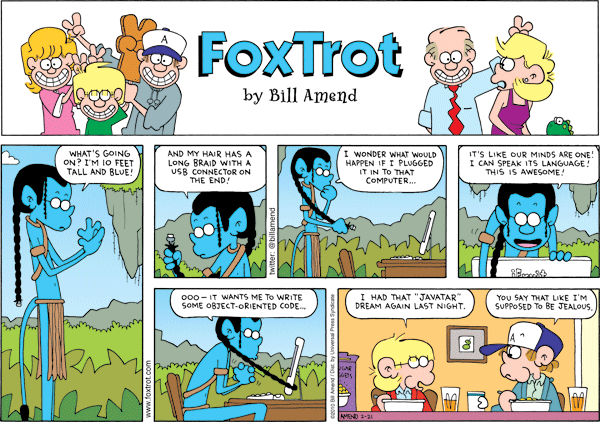
I'll start with a very simple concept, one I'm sure you all can understand. A comic strip.
This is, actually, a surprisingly accurate representation of the Na'vi. Since you're reading this I assume you have a computer, and if you have a computer you're probably aware of what a USB is. Just in case you aren't, USB is how various devices are connected to each other. You use a USB cable to connect your MP3 player to your computer to transfer music. You use it to download pictures off your phone. It can be used for recharging, and for data exchanges.
Well, the Na'vi have the equivalent form of connection in the neural connectors at the base of their skull. Animals have two each, right behind the ears. When the ends of these fibre optic type connectors are laid together they connect, allowing information to pass from one mind to the other, much like data along a USB cable.
Cool, huh? But it gets better. The trees are connected neurally through the roots, so the entire forest is in communication with each other, spreading information around. The mistake the Na'vi made was worshiping the earth as a goddess, Eywa, when in reality it's just a huge data bank. One of the characters describes it thus:
What we think we know - is that there's some kind of electrochemical communication between the roots of the trees. Like the synapses between neurons. Each tree has ten to the fourth connections to the trees around it, and there are ten to the twelfth trees on Pandora... That's more connections than the human brain. It's a network - a global network. And the Na'vi can access it - they can upload and download data - memories - at sites like the one you just destroyed.
So, in other words, the entire planet is like a hard drive. And trees like the one pictured below are USB ports. And through the neural connectors coming out of their heads the Na'vi can "plug-in" and access the memory. They can store memories there, experiences, knowledge; for future generations to access and learn from.
Even the rituals they engage in, holding hands and singing around such a location fit in. They're forming a giant processor. Individually they're weak, but together, all striving for the same thing, they become very, very strong. There's really nothing religious about it all. And what they could do if they understood; imagine the potential for that kind of information sharing. They'd never need to develop technology; because they are the technology. The concept is mind blowing. The potential is staggering.
Now can you see Avatar in a new, scientific, light?
Spring does not come gently to my state. It comes violently; passionately. It is flirtatious, faithless, and breathlessly beautiful. It takes you when you least expect it, after leading you on forever. I have heard it said that before spring comes we must suffer through seven winters. Yet in the ten years I've lived here I've only seen three.
Mid-January comes the January thaw, when the world is warm and lovely and the bees come out to eat. The bees could not survive a winter without that little breath of spring half way. February comes cold and bitter, with snow and ice. But through the snow peeks the first hint that winter draws to an end... daffodils.
The daffodils bloom in February and March, and gradually the cold fades. Coats are put away, shoes are discarded, and you begin to look forward to the blooming of the leaves. Warm breezes blow... and it rains. It rains and rains and rains. The world turns to mud, and if you get a glimpse of sun you cherish it, for it is but a fleeting glimmer.
Creeks flood, and overflow their banks. Half the roads in the county become impassable. The fire station stays busy. Tornadoes are seen. The weather site of your choice becomes one of the first things you check every morning. You keep an eye on it through the day. You clean out your storm cellar. You keep your cattle up near the house.
A Redbud Tree
Just about the time you're ready to pack away all your winter gear and start planting your harden... it hits. In thunder and lightning and high winds, it sweeps across the land inspiring terror and awe. Sometimes disaster follows; sometimes it does not. But what inevitably follows is bitter cold. From the north comes an ice wind; not so strong as the west wind, but cold enough to bring out the warmest blankets, socks, and gloves. Hot cocoa suddenly resurfaces. You're glad you didn't finish off your wood supply. Winter isn't over after all.
Gradually it warms up again. You discard your winter gear. You go outside to delight in a warm spring breeze, and stop to gasp in delight. Spread all over the barren, brown forest is a pink blush. The redbuds have bloomed. The first winter has passed.
March passes in a whirlwind of flood waters and kite weather. The storms are less violent, but still frequent. Sometimes there's disaster, sometimes not. Planting begins. Spirits soar. The first pale leaves appear in the forest. You pack away the winter coats, boots , and scarves. Children run around and get muddy. You give up on mopping the floor every day.
And then... it comes again. Freezing rain, and wind, and gales. The outside world turns to mush. Baby chickens huddle under their heat-lamps, and calves cry for their mothers. Tender plants are brought into the greenhouse, and from the attic you bring back down warm jackets, and raincoats. It rains for three days. When it's over the world is clean and bright, vibrantly bright under a sky that still remembers being dark. And it's crisp and cool. A chill runs through you as you inspect your planting to be sure it's survived. You pick up trellises and re-tie tarps. You glance out towards the forest and a glimpse of white catches your eye. The Dogwoods are in blossom. The second winter is over.
A Dogwood Flower
The leaves come out, first in bright green, quickly darkening. April comes. The grass shoots up in leaps and spurts. You fix your fencing and set the cattle out to graze. The lambs grow quickly, skipping through new clover. The peas are growing, and flowers spurt up all over. The wind is gentle, beautiful, calling you to come and dance, to run and play and sing. There's something in the air that begs for adventure; there's something in your heart that cannot stand still.
The rain comes less often. The rubble from the disasters are picked up and gone. You begin to daydream of fairs and picnics and outings. You rediscover things like boating, and archery. It gets warm some days, warm enough almost to believe that spring is well and truly here, and that summer is on it's way. But it's not over yet. Not quite.
Snow in April
The third winter comes unexpectedly. It doesn't leave in a hurry. Some days it gets cold enough to rival February. Sometimes you decide you need a fire, but the stove is buried under piles of spring time paraphernalia. This is the winter of hail and flurries. Snow against the bright green leaves make a strange contrast. Through the cold lurks a breath of warmth, and everyone marvels "what strange weather we're having!"
The water from that winter sticks around for a while. You keep your mudboots close at hand, and shiver when you go out in the morning. You clean the fallen branches off your fence, and curse the brambles that seem to sprout out of nowhere. But as the weather warms again, and the dew burns off the grass and the sun shines hot over the swiftly growing grass, and you begin to think of summer, you notice. The blackberries are white with flowers. The third winter is gone.
The blackberries will not be ripe to eat until June, but this blossoming is their promise that June is not so far. Within a week or two the raspberries will ripen. Soon May is right around the corner. In the scorching heat you forget the flowers, and the spring time. In the joys of swimming it seems winter never came. For May is summer and haying and sunshine; the time of spring has passed.
I recently read a book; Firebird, by Kathy Tyers. Yup, you know, the one I keep ranting about. It was a science fiction romance. The reason I can't get it out of my head is because I recently classified by own novel as a science fiction mystery romance. So I'm here to explain the difference between a romance and a Romance.
A Romance is character driven. You can have character driven fiction without having Romance, but you cannot have Romance without it being character driven. It works like this.
In the beginning there was the Romance.
Then there were the characters, who affected the Romance.
Then there was the plot, which affected the characters, which affected the Romance.
Then there was the technology which affected the plot, which affected the characters, which affected the Romance.
The Justice Project is character driven, but it's also a mystery. So it looks more like this.
In the beginning there was the mystery.
Then there was the technology, which affected the mystery.
Then there were the characters, which affected the technology, which affected the mystery.
Then there was the romance, which affected the characters, which affected the technology, which affected the mystery.
Romance is a loving relationship between a man and a woman as it occurs in the plot. It's usually a plot device, used to toss the characters into conflict and confusion. Romance can serve any purpose, from splitting friends apart to reuniting estranged families. It's an extremely useful tool.
Romance, on the other hand, is the plot. Symptoms that your book is a Romance may include long internal monologues on the part of the involved characters, usually related to how they feel. Angst is bound to be present in some form. Even if the world is at stake all your characters can think about is each other. Even if they hate each other all the characters can think about is each other. Even if there's a billion more interesting things going on elsewhere all they can think about is each other. Even if the reader is bored to tears... all they can read about is internal monologuing about each other.
I do not write Romance. I use some form of romance in almost every book I've written. I never sit down to voluntarily read a Romance, but somehow I keep tripping across them. It doesn't help that my mom and my sisters really enjoy them. However, I have nothing against romance, either in real life or as a plot device! I have described myself as a fairytale writer, and I'll stick to that assertion until the day I die. And we all know that fairytales are just love stories.
My faithful heart is my only charm,
But my good broadsword is keen.
And love for the princess nerves my arm
With the strength of ten, I ween.
Come weal, come woe, no knight can fall
Who goes at love's bequest...
~ from The Rescue of Princess Winsome
It's a verticle feed mixer. Inside there's an auger that goes round and round, and mixes up the feed before spitting it out of the chute below. I saw these things fairly often from the time I was ten. We have a fairly large one lying sideways in our front yard, and we used to climb in it and pretend it was a space ship. It greatly resembled part of a rocketship, as we remembered it from the movie Apollo 13. We also pretended it was a submarine.
One year, for Christmas, we got the most remarkable present. Our parents got us the 10th Anniversary Collector's Edition of Myst: which included the DVD version of the first three games in the series. We'd played an old version of Myst on an even older laptop (it ran Windows 98, as I recall) and we were very eager to play the sequel; Riven.
Riven did not disappoint. It was an amazing game. Except that we wandered through the entire game wondering why on earth Gehn needed a feed mixer, and where was this telescope everyone kept talking about?
I watch a lot of TV shows on Netflix. I argue that reading is better than movies, that Television is the biggest time waster ever, and that I have better things to do besides play computer games, and yet I go through a new show about every month. Today I am here to defend this practice to the world.
I don't just watch TV shows, I watch scifi TV shows. Star Trek, Stargate, Firefly, Dollhouse, Doctor Who, and Sherlock, to name just a few. My favorite movies are scifi: I, Robot, Tron, Tron: Legacy, Antitrust, etc. I have never seen the Lord of the Rings movies. My fantasy TV picks are limited to Robin Hood and Once Upon A Time. I enjoy very few fantasy films.
I am a writer of both fantasy and science fiction. So how come I prefer to partake of fantasy in written form, but science fiction visually? The first question needs to wait for a future post, the second question is coming up now.
The grand masters of fantasy are Tolkien and Lewis, but also Rowling and Paolini, and dozens of demi-master, and writers of smaller fame but equal quality. The acknowledged grand masters of science fiction are Isaac Asimov and Robert A. Heinlein. I, Robot and 2001: A Space Odyssey are possibly the most well known works of science fiction, with the possible exception of the works of Jules Verne. These writers are fifty years out of date. No one has risen to challenge them. No author has achieved their status, or equaled their work. How hard can it be to trump science fiction so old that we laugh at their future predictions? And yet, when you think of science fiction, what comes to mind? Star Wars. Star Trek. Stargate.
Oh, there's Ender's Game, perhaps, or the works of Jerri Prunelli, but they're still small players compared to the grand scale of the fantasy genre. Face it, in written fiction the science fiction genre nearly doesn't exist. When you do read a science fiction novel you can't expect a fun adventure story of life on a space ship. Science fiction writers wrestle with deep questions like atheism, and life after death. Many science fiction is more fantastical then the highest of high fantasy. Many of them read like a doctorate thesis disguised in a plot.
If an aspiring SF writer wants to learn about things like warp drive, hyperspace, spacial distortions, and other fictional science, where is she to go? To novels like "Revelation Space" where the plot centers around the idea that stars are sentient? To "A Pebble in the Sky" that simply tries to prove that environmentalists are right about radiation from the sun? What if you don't care about the politics of today in relation to what you're writing? What if you want character driven stories with SF elements?
Television doesn't have an agenda. Television can only be profound for a few moments, because then the episode is over and the characters go on. Television has the chance to put a lot of truth into just a few minutes, because they're on a time schedule. Sometimes they skip the meaningful content altogether and just get back to shooting aliens.
From "Firefly" I learned how realistic science fiction can be.
From "Dollhouse" I learned how quickly technology can change.
From "Star Trek" I learned how alien characters can affect the plot.
From "Stargate" I learned a whole lot about physics, and the lack thereof.
From "Star Wars" I learned that a fantasy plot can become scifi with just a few twists.
From "Antitrust" I learned that science fiction doesn't have to be futuristic.
From "Tron" I learned how extraordinary ordinary modern technology can be.
From "Doctor Who" I learned that there's an explanation for everything.
From the written world of science fiction I learned that for a good writer, the sky is the limit.
My current project The Justice Project depends heavily on a lot of complicated telepathic concepts. As a result I've done a lot of heavy thinking on the subject, as it should be written, and while I'm not entirely sure how much of it is helping me, I decided a comprehensive post was in order.
Mind-Speaking
Mind-Speaking is the most basic form of telepathy, and is the one people most commonly associate with the term. You sit there, I sit here, and we talk to each other without moving our lips. Such conversations are typically written like ordinary dialogue, usually in italics.
Dude. I'm trapped in this prison cell, can you still hear me? Yeah, dude, I'm in the one right next to you.
Mind-speaking may or may not be achievable over long distances, depending on the writer, the world, and the rules of the world. Commonly used when communicating with dragons. Examples of books that use mind speaking are Eragon, and The DragonKeeper Chronicles.
Vulcan Mind-Meld
Mind-Reading
Mind-Reading is the next step up, the one usually found in more science fiction type works. There are two forms of mind-reading; the Touch Telepath, and the Intrusive Psychic.
The Touch Telepath requires physical touch in order to communicate with another's mind, and generally must obtain permission of the person who's mental privacy they're invading. There are certain safeguards allowing you to sheild some thoughts from the probing of the mind-reader, such as imagining a closed door. Examples of Touch Telepaths are the Doctor from Doctor Who, Spock from Star Trek: The Original Series, and (in this case a villain) the Wraith from Stargate: Atlantis.
The Intrusive Psychic has advanced mental abilities, and does not usually require any sort of physical contact to invade their victim's mind. The victim may or may not be aware that their mind is being read. The Intrusive Psychic rarely asks permission, and often uses their skills to impress others. Examples of media featuring Intrusive Psychics are Inception, and some episodes of SeaQuest; DSV.
Mind-Control
Mind-Control is one form of telepathy that is universally acknowledged as wrong. Mind-Control is the result of a very powerful mind-reader, often with the aid of advanced technology or magic, taking over the mind of their victim, so that the victim is forced to do whatever the mind-reader tells them. Also a form of hypnosis. They may subtly alter how the mind functions so that the victim will act of their own free will in the interests of the mind-reader.
Memory-Sharing
Memory-Sharing is an extremely powerful means of communication between two telepaths. The memories shared directly can be very strong, sometimes causing identity confusion. The only examples of Memory-Sharing that I've encountered is the fictional series The DarkTrench Saga
Group Memory
Group Memory is a phenomena observed only in telepathic races and cultures. While not yet forming a group mind each individual will have an awareness of their people as a whole, often being able to access memories seen by their ancestors. When a great devestation occurs most members of the race can usually sense it. Examples of telepathic races known to show these aspects are Vulcans (Star Trek), Time Lords (Doctor Who), and Na'vi (Avatar).
Group Minds
Group Minds are a more sinister aspect of being part of a telepathic culture. It is the biological equivalent of linking several ordinary computers together into one, huge supercomputer. Individuals loose a large part of their identity and, in some cases, may loose any sense of individualism at all. The minds function as one unit, with each member acting for the good of all. Examples of group minds are the Borg (Star Trek), the Cybermen (Doctor Who), and the Attic (Dollhouse - maybe be incorrectly categorized).
Other Aspects of Telepathy
Cyberman
Other aspects of telepathy are used in fiction, although, strictly speaking, they're not telepathy as such, but more of general psychic ability.
Matter Manipulation
The telepath who can manipulate matter into other shapes may or may not actually be channeling energy from another source. Also known as transmutation, this skill is fairly rare. It may also include the ability to cast an illusion.
Teleportation
Usually seen as a strictly technical or magical ability, teleportation can be achieved in some instances by telepaths. Usually by simply wishing themselves elsewhere they can succeed in changing their actual location. This is about as plausible as "lifting yourself by the seat of your pants" but by employing other senses such as television, super hearing, and telesmelling a strong enough telepath can move himself and anyone else who happens to be coming along to another location in a method very similar to many teleportation devices with much less trouble and expense. Examples: Harpist in the Wind (Riddle of the Stars).
Networking with Electronics
Often an aspect of being a Cyborg, this may or may not actually qualify as telepathy. The individual who can directly connect to a computer usually does so by means of a neural implant, rather than by more traditional telepathic methods. Yet it could be said that such implants are themselves a means of enabling lesser mind to achieve an aspect of telepathy they might not otherwise possess. Examples include R2D2 (Star Wars), and the DarkTrench Saga.
Shapeshifting
Usually an instinctive ability the individual is born with, shapeshifting can often be obtained by mental discipline. Often adopted by energy beings, it is sometimes seen as the ultimate victory of mind over matter. Examples of shapeshifting (or appearance altering): Riddle of the Stars, and Star Trek. Examples of energy beings: Stargate: SG-1, and The Adventures of Lucky Starr (Isaac Asimov).
Horror is a genre often discussed among my Christian writer friends. They say: can horror be Christian? Is it edifying? Should we read it? What makes it horror rather than thriller? I do not participate in such topics. I stand on the other side of the room with a look in my eyes that says: "Stay away from me, you freaks."
I, obviously, don't like horror. As an example of this, the following conversation occurred recently:
Friend: Do you not like scary stuff?
Me: No. Hate it.
What I realized, upon reflection, is that this is a complete untruth. I love scary stuff. How many times have I been told "the ending was horrible!" or "don't you ever write anything happy?"
What is more "scary"? A creepy monster crawling out of a graveyard or the prospect of a loved one dying? Which is more horrifying; a ghost appearing in your bedroom or a paper you're forced to sign, agreeing to allow experiments to be conducted on your mind?
I write horror, of the most chilling kind. You won't find the unbelievable hair raising elements commonly associated with the genre, but what you will find won't be so easily forgotten. What you'll find is not the dark ravings of a lunatic but the cold calculations of a perfectly sane mind.
“You hate me,” she said finally. “Because of what I am. What I could do.”
“No,” he said swiftly. “Never. Don’t say that. It’s not your fault.”
“I’m not human,” she protested. “I’m just a… a thing.”
Dorus swore. “You’re far more than a thing,” he said brokenly. “What they did to you was an atrocity, an outrage, but it doesn’t change who you really are.”
That is my kind of horror; the brutal reality of what is, or could be. The perversion and wrong-doing that can be imagined by the human race. Ethical and moral dilemmas of the sort you hope never to have to face. Which would you rather face; a mad man wielding a blood stained sword or the betrayal of the person you trusted most in the world?
If we must die, let it be at the hands of strangers, for a friend can make us suffer so much more!
And what can be more truly horrifying than the prospect of Eternity... alone?
Every time I mention either of those names an entire saga comes to mind that I feel compelled to tell. I never do, though. Tolstoy and Dostoevsky are both Russian authors who had almost as huge an influence on my writing as Shakespeare, and that's not mentioning how they influenced my life. Their writing is absolutely incredible, if a little dark. It reflects Christianity perfectly, without being preachy. Even the preaching is intensely dramatic.
But first let me tell you how either name came first to be mentioned in my father's house. It was a stranger who moved into our area one day, and did a little fencing for my father. He became very interested in the local Mennonite community, but against my father's advice. He was smarter than most who were beguiled by their pretense at righteousness, but he couldn't resist their spell, either. He refused to accept their money or their aid, disdaining to be beholden to them, choosing rather a life of poverty for himself and his family.
Nothing in the bible is pointless, he told my father. Every last word is there for a reason.
He took the blind man by the hand, and led him out of the town; and when he had spit on his eyes, and put his hands upon him, he asked him if he saw ought. And he looked up, and said, I see men as trees, walking. - Matthew 8: 23-24
Even the reference to trees has significance, he said, if you know what to look for. It's not a random description. It has meaning.
Tolstoy was impressive and endearing. Dostoyevsky has no equal. When my father later bought "Brothers Karamazov" I read it, all 800 pages. He found it boring and gave up half way through, but I was riveted, and forced him to finish it. He wouldn't let me read ahead of him, so we raced through the second half of the book, with me catching up on everything he read during the day, and waiting impatiently for more.
Fyodor Dostoevsky
Brothers Karamazov was good, but what I really wanted was "The Idiot." I stalked the library until I found it, a tiny trade paperback that was almost impossible to read with it's small print and huge page count. I read it anyway, caught in the pathos of the tale and marveling at the character of Myshkin; still one of the most sympathetic characters I know.
That was my introduction to Russian literature, and it marked a major change in my life. The Grand Inquisitor is an excerpt from Brothers Karamazov that I quote at every possible occasion, and was the main inspiration for my science fiction novel: "City of Lies." Both Tolstoy and Dostoevsky writing stories that I can go back and reread for ages, nevermind how long or short the tale.
What became of the remarkable man who brought this name into my life? He was baptized into the Mennonite church, and scarcely a month later he bitterly regretted his mistake. He attempted to leave then, but they brainwashed his wife and daughter into staying behind, and he would not leave them. The compromise he made was costly; he took his family half way across the country, promising to arrive in another Mennonite community, but never planning to arrive at his destination. He left abruptly, without fanfare, and we do not know for sure where he is today.
Two copies of Tolstoy sit on our library shelves. One is our own, and one is borrowed, still waiting to be returned to its owner. Every time I go in search of a book I see them there, side by side, identical, and it reminds me of this story, of that strange time in my life, and of how a little bit of Russian first crept into my writing.
I couldn't watch Green Lantern with a straight face. There were far too many similarities between the protagonist, Hal Jordan, and the villain of Megamind, Hal Stewart.
Let's start with the obvious: they're both named Hal.
They both wear really dorky masks that don't really conceal their identity.
They both float down to the girl's railing in an eerily similar scene...
They're both made unwilling heroes.
They're both real life failures.
The differences, however, make up for it, since Green Hal makes all the right choices and Red Hal does not. Green Hal becomes a hero because he cares about the people around him, and Red Hal becomes a villain because he cares only about himself. But they started, essentially, at the same place.
I feel myself all properly prepared for Avengers this spring. I finally gave in and put a hold on the three newest superhero movies from the library; Thor, Captain America, and Green Lantern.
Captain America
This film taught us that ordinary people can do extraordinary things, but only if they're genetically enhanced. I would have liked this movie much, much better if the small guy had proved that being small doesn't mean you can't succeed. Instead he proved that being small is useless, but if you keep trying some mad scientist will make you the big guy. The shield should have been superpowers enough. I wanted to see the shortest guy in the entire U.S. Army succeed, and I didn't get that. I was quite annoyed.
My favorite character from Captain America was Howard Stark. Watching this movie made me suddenly more interested in seeing the first Iron Man movie. Geniuses who develop cool tech are my sort of hero. The shield was super cool, but I had a refrigerator moment the next day when I suddenly realized that every time I saw Steve throw the shield I was making an association with Tron. (It's round, you throw it, and it comes back to you.)
Thor
Thor was my favorite of the trio! We actually watched this one as a family. It was a little too intense for my little sisters, though. They tend to get overlooked when it comes to whether or not a movie is suitable. I was also gratified, when I looked up my Norse Mythology, to find out that the movie was more or less accurate.
My favorite character was Loki. Loki always has and always will be my favorite of the Norse gods. His character was extremely well developed, and his motivations were both realistic and totally tragic. I feel so sorry for him, and the Avenger Trailers are not changing that for me.
One thing I thought could have been done better was actually in the editing. Several of the deleted scenes cleared up parts of the movie I found confusing, specifically the ones before Thor's coronation. If they needed to make the movie shorter they could have cut out some of the interminable fight scenes that dragged on for absolutely forever.
Green Lantern
I didn't realize, until after I started watching this movie, that it's not Marvel! It's DC Comics, which suddenly makes my brother's friend's comments about a Justice League movie that much more sensible. Although, with Christopher Nolan remaking the Batman and Superman series a Justice League movie starring those two alongside the types of Green Lantern would be a little incongruous.
I got to watch this one with my brother, which means I got to sit there and make all sorts of snarky comments like:
The mask looks like a bird beak, and really doesn't protect against identity.
Any organization that's been in existence this long has big problem.
The entire Green Lantern Corp is a bunch of over-confident wimps.
"The Emerald Energy of Will..." (say it with a whispery, mysterious voice.)
Overall, I actually liked this movie. I liked the green. I liked the random guy factor. I liked the fact that his girlfriend was intelligent. I had serious problems with the scientific plausibility of the source of power of the two opposing factions. And the guardians are a bunch of idiots. It's definitely not your typical superhero story, and that definitely gives it brownie points. The sequel looks promising, but could we please loose the stupid mask?
In a study performed today it was discovered that if you correctly spell the search terms in any ordinary web search you are 97.45% more likely to get helpful results.
"It's astounding," representative for the GN* said, when asked about this new development. "Not only does good spelling look better, it's actually more functional."
Participants in today's test were given several words to define using the well known Google Search Engine. Those who spelled the words correctly came up with positive results 150% faster than those who had typos, according to test results. Many of those who used misspelled words didn't come up with any accurate results until they used the correct spelling.
"This study is just proof of what GN has been saying for years," a pro-grammar participant said. "It's amazing to finally see some people standing up and saying "This actually works. This is something we should encourage.""
Opposition to the GN movement had little to say on the subject. Misspelled search terms can often lead to unwanted, or even inappropriate, results. Misspelled words can have similar results in other usages as well. Imagine writing an e-mail to your grandmother and leaving a letter out of "Hello."
"Everyone should learn to spell," GN representative said in closing. "There's no question of whether or not it's worth learning; it is definitely worth learning."
Further studies are in progress, and results are eagerly anticipated by both sides of the grammar debate.
"Another such victory over the Romans and we are undone."
- King Pyrrhus of Epirus
"Although it is, I admit The tiniest bit Unlike I anticipated There's a kind of a sort of... cost. There's a couple of things get... lost. There are bridges you cross you didn't know you crossed until you crossed! And if that joy, that thrill Doesn't thrill like you think it will Still, Who couldn't be happier? Because happy is what happens when all your dreams come true. Well, isn't it?"
- Wicked; Thank Goodness
This is one of my favorite, most tragic concepts in all of life and fiction. It's found strongest in stories of anti-heroes, where a previously evil character suddenly finds himself in possession of everything he's been fighting for... and it's not what he expected. In retrospect Megamind had the perfect life. After he defeated his superhero nemesis he lost all purpose in his life. Dr. Horrible achieved his life time goal at the end of the film, but at a price he would have never paid if he had known what he was getting into. Suddenly their innocence, such as it was, is shattered.
"I've been looking out of a window for eighteen years, dreaming about what I might feel like when those lights rise in the sky. What if it's not everything I dreamed it would be?"
- Rapunzel, Tangled
Pyrrhic Victory is possibly one of the worst things that could ever befall a warrior. It would be better to face defeat, then to win such a victory. How can you call it a victory to finally grasp your crown... alone? How can it be worth the cost to destroy your enemy, and discover that he was your friend?
"You may win this war, Commander, but I promise you, by the time it's over, you will have lost so many ships, so many lives, that your 'victory' will taste as bitter as defeat."
- Star Trek: Deep Space Nine - What You Leave Behind
In the bible we are commanded to give up everything and to follow, to earn a treasure that moth and rust will not corrupt nor thieves break in and steal. Pyrrhic Victory is the inverse of this, give up that treasure, to gain everything on earth. Regardless of your religion, the principle is the same. Is the world worth the weight of your soul? Is your pride worth everything you've ever loved?
For years there have been rumors, vague whispers in the dark, obscure references, and cryptic status messages. Many are excited about it, but for most the question remains: "What is The Tale of Pirate Shishkabob?"
Once upon a time there was a pirate known as Shishkabob. He was a great and terrible pirate. His flag was feared all over the seven seas.
Pirate Shishkabob is a children's book I wrote two years ago. It came about when my brother, dressed as a pirate, was helping us make shishkabobs one night. All my life I'd thought they were called simply kabobs and it was a startling discovery to find that was a mere abbreviation. It was a fun word to say, and it was a fun title to apply to my pirate brother who loved the dish. Add in the fact that skewers work wonderfully as swords and we had ourselves and entire role play worked out. Thus the character of Pirate Shishkabob was created, and this is his story.
Summer of 2010 I was looking for an illustrator for two children's stories I had written. Shishkabob was one of them. I mentioned this fact on a forum thread, and it was seen by another member. We got to e-mailing, she sent me some concept art, and Pirate Shishkabob walked into full color for the first time. I was completely convinced, and we worked together on an outline. By December she'd sent me over thirty pages of artwork, and the tedious process of formatting began.
My on-again, off-again work schedule slowed the process down considerably, and it wasn't until Summer 2011 that I finally started serious work on Shishkabob again. In the end of November I finished my first in a very long line of interior pdf files, and am in the midst of an ongoing battle with margins, print resolution, and the blurring of blank pages. However, it is looking hopeful that this project will be finished shortly, and thus I present to you what is likely to be my first published work!
The Tale of Pirate Shishkabob is a delightful 45 page picture book that tells of the adventures of some very hungry pirates. Illustrated in vivid colored pencils, it even includes a recipe in the back so that you can make your own Piratey Shishkabobs when you've finished the story.
Joss Whedon may be my favorite Storyteller, but James Cameron is my favorite filmmaker. I've seen two of his films: Titanic and Avatar, and both were breathtakingly beautiful. They may not have had the more original stories, or been the most historically accurate or logically sound films, but you don't realize that when you're watching it. When you're watching one of his movie all you think about is what he wants you to think about, all you see is the beauty of his worlds.
Titanic
There are two reasons why people don't like, or won't watch, Titanic. The first is content issues. The second is the tragedy aspect. We'll deal with the content first. To begin with, it's not as bad as people think it is. My mom, for example, thought that one of the characters was a prostitute, which is not so. The plot, however, revolves around a drawing, and the drawing is of the main character without any clothes on. The drawing is shown several times, and the scene where it's actually made is part of the climax of the film. But, overall, it's cleaner than Firefly. One girl I talked to said it's not a film for mixed company, and that about sums it up. When I watched it is was with my younger sister, her best friend, and her best friend's grandmother who's house we were staying at.
Now on the other hand, if you're not someone who doesn't like tragedy, you might be very well advised to stay away from this film. I cried. I cried through the entire second half. The story, in a nutshell, is of a young woman named Rose being pressured into marriage with a controlling man by her overbearing widowed mother. Her mother is concerned only with the money she'll get out of the match, allowing her to maintain her place in society, rather than have to face the prospect of working for a living. Rose is dissatisfied with her pointless life of luxery and despairs to the point of being ready to take her own life. She is saved by a witty, penniless young man named Jack who is going to seek his fortune in America. He saves her twice, but his actions put them both into compromising circumstances.
Rose and Jack continue to see each other. He becomes her only friend, and takes her to the lower decks to parties with other passengers of his class. She finds real companionship among the poor, and a meaning to life that she'd never experienced in her own class. He saves, not just her life, but her soul. He teaches her to live, to love, and to give.
Is it sad? Of course it's sad! It's about the Titanic. Everyone dies in the end, and it's long, drawn out, and horribly tragic. I'm told by people who know such things that it's woefully inaccurate historically, and I'll take their word for it. At the same time, though, it shows the reality of what disaster is like, especially when brought about by pride, and how cruel human nature can be.
I've recently heard Titanic accused of feminism. Try as I might I've been unable to figure out how this can be. Feminism is women's desire to take the place of men in society. Titanic is a romance, with no opportunity for that kind of worldview. Rose chooses to take her life into her own hands rather than continue on the path chosen for her, but that's rebellion, not feminism. Her father is dead, and she is unmarried, so she's not even rebelling against a male authority. Rebellion is not always wrong. Choosing to follow Christ when your family forbids it is rebellion also. One might frown upon her reasons for rebellion, but it's not feminism.
Can we get to the good stuff now? I loved this film. To answer the perennial question: if I could choose one film, only one, to study to become a filmmaker, it would be this one. There isn't a single shot, a single light cue, a single line that wasn't carefully thought out and placed to make an impact on the viewers. The cinematography, the acting, everything blended together beautifully. It was amazing. I have never seen anything like it, before or since. I would recommend this movie, in spite of it's content, to anyone who wants to study film. If you object to nudity keep a remote on hand and skip those scenes. There's only two or three, and the rest is sheer beauty.
Avatar
I saw Avatar twice in theatres, first in 2D with some siblings and then in 3D with my father. The general consensus is that it's better in 2D. If there was an award for worldbuilding this film would win, hands down, in film and in literature. James Cameron blends alien with the familiar just enough to create something both amazingly different, and beautiful. Sure, the story is basically Disney's Pocohantis, and if there was a sequel in would involve nuking Pandora from orbit, but you don't think of those things until later. You don't care, because the entire reason you watched the film was for the scenery.
A lot of time, when authors take it upon themselves to invent a new landscape, it becomes garishly different. Stray too far from the beaten path and all you have is strange, not beautiful. We, of ourselves, are not capable of creating beauty. We can only embellish beauty that already exits. Reading "Out of the Silent Planet" made me positively dizzy when I tried to picture the bizarre landscapes the Lewis described. Watching Avatar was simply breathtaking. Everything was bigger, and everything was blue. He used bio-luminescence liberally, and colored everything in blue and purple. He drew heavily on colors of the night, and messed with the laws of physics as only a true artist can do.
The aliens win a prize all their own. Most aliens tend to look either like Vulcans or Moties; practically human or totally weird. The Na'vi strike a nice balance. They take some getting used to, but we can recognize them as people, rather than animals, and they have their own kind of beauty and grace. And by the time you walk out of the theatre you've decided you want a tail of your own.
Content issues for this film are pretty simple; none of the natives wear any clothes. Well, for practical purposes. It didn't bother me one iota, because the aliens are eight feet tall, blue, striped like a zebra, and have tails. Other people think differently, however, so there's a very simple test. Look up any picture of Neytiri and see if it's something you're comfortable watching for three hours, because that's what she looks like for the whole thing.
Then there's the religion aspect. At first you're kept guessing whether or not it's going to turn into some weird new age/mother earth time piece, but eventually we find out it's actually a form of Whovian Science. It may sound like a religion, but there's actually an explanation: the entire planet is telepathic! Now that is downright cool. (My favorite Doctor Who/Avatar crossover is A Moment of Peace. Whovians will enjoy it, even if they haven't seen Avatar, just 'cause the idea of a telepathic planet is cool!)
Music
Have I not mentioned music yet? Both films were scored by my favorite film composer; James Horner. The music for Titanic carries the plot perfectly, and the love theme is enough to make most people cry regardless of if they've seen the film or not. The entire score speaks poetry and urgency at intervals, never completely letting you forget that this is a tragedy, never letting you forget that this is a romance.
The score for Avatar is simply amazing, in my uneducated opinion. The rhythms are unique, the tones are unique, and let's not talk about the key changes! One reason I was really excited to see this film was because I knew James Horner was scoring it, but then I kept forgetting to listen to the music. (Which is a good thing in film, since the music should not be obtrusive.) When I did, however, I was not disappointed. Listening to the soundtrack makes you feel like you're flying. The theme is one of my favorite songs by him, ever. It's one of the few songs I can identify that actually uses a parallel major, instead of the relative. To put it simply, it's amazing.
In Conclusion
Put James Horner and James Cameron in the same film and you're sure to have a winner.
James Cameron may not have the most incredible or unique stories, but he's talented enough to make you not care. Imagine if James Cameron made Joss Whedon's films... I have never heard anyone quite give Titanic justice, and Avatar seems like one of those often underrated films. Hopefully this review served to give a more balanced view to two of the most influential films in the modern history of filmmaking.
Let's see, where do I start? Tron... I saw Tron:Legacy for the first time on vacation, actually, at a friend's house. I also saw it for the second and third time. The family I was staying with watched it in groups. The parents one night to approve it, the boy the next afternoon because he thought we wouldn't like it, us girls that evening when we insisted we would, and again the next night because the little boys had to go to bed the previous evening. Told from the start it was boring and pointless I and my friends were, of course, determined that it wasn't.
I didn't fall in love with it, to start. I was intrigued, definitely. It wasn't boring, but it was confusing. I theorized that it was heavily based on the original Tron, and that the filmmakers mistake was that the people who'd seen original Tron had forgotten it, and the people watching Tron: Legacy had never seen the original. Ultimately it was the discussion, the confusion and the warnings of boringness that made me really fascinated.
I came home with this otherwise pointless movie on my list to see again after I saw the original. I hunted down the original, and suddenly was converted. Legacy has little to do with the original Tron, although there is tribute after tribute nestled into the cinematography. Somehow, though, I liked both. Tron is old, the graphics are old, and the plot is a little flat. But I loved it. I loved the characters. I loved how noble the character Tron was, I loved how potentially dangerous theology was easily dispensed with.
From left to right: Tron, Ram, and Kevin Flynn
Tron: Legacy did not deserve it's name. Tron isn't even in it. Well, he is but... [spoilers.] I've heard it said that it should have been called Flynn's Legacy, but the how would we have connected it to the original, eh? Anyway, titles aside, Legacy is of interest as a film student, if nothing else. It's as much on the cutting edge of what's possible in film as its predecessor was in its day. The cinematography is startling, as it centers heavily around light. Everything seems made of light and glass, and is blue or orange on black. While this is very unique, it personally gets tiring on your eyes after two hours. A lot of people probably will find Legacy boring. It has a lot of rather long lightcycle chases, and it successfully put my dad to sleep. But the real reason this is one of my favorite movies is the music.
When my friends younger brothers were watching it the next night I originally started out in the kitchen playing go fish. We could just make out some of the sounds from the movie through the wall and on occasion I would life my head and listen thinking "That's really cool music." It's more than cool music, it's brilliant music. It's become one of my favorite soundtracks. You can read more about the music in a review by Aubrey Hansen.
In summary, my favorite character is Tron which makes me very excited for Tron: Uprising next summer. I think that both movies have equal merits and were brilliantly done. They may not have the most original plot on the block, but they've certainly got a unique premise. And just to prove how much I loved them I made this nice mashup with my favorite (and only) computer game, Myst.
As ya'll know, I'm a bit obsessed with Doctor Who. It's influenced me heavily, both as a person and as a writer.
First, let me take a moment to do something very brave, and explain that I am very, very much a pacifist. I cannot justify any war, any where, or for any cause to myself. I don't usually talk about it; it's my own conviction. So it was unusual for me to start a thread on the subject on my favorite fantasy writing forum.
The Doctor is not exactly free from innocent blood. He's responsible for the deaths of millions. He kills when he has to. He's committed genocide multiple times. Almost every episode deals with death is some form. And that is exactly what makes the show so powerful; because he grieves over every single life. Bad guy, good guy, friend or enemy, it doesn't matter. Whether it's thousands who perish as a result of him saving the world, or just a single being he grieves over it. He may not see much, but it never goes unnoticed or unmentioned. Everything comes at a price, and the makers of DW make that price abundantly clear to us.
One night Netflix vanished on me, so I settled down to watch another show you've heard me mention, Stargate. I realized my worldview had changed. Whenever they save the world, there's a price. Shoot and run, leaving a trail of dead enemy soldiers behind you. It never occurred to me to question that before; it's not a deep philosophical show about death. But how many books have you read and how many movies have you watched where random people randomly die for random reasons and no one mentions it again?
No one cares. Even when there are regrets, it tends to be an offhand "For what it's worth, I'm sorry I had to kill him." No one grieves. Not even in real life.
Every day across the sea people die. American troops, yes. Innocents caught in the crossfire. The enemy. We pray for our troops, but is that all you can do? What happened to the sanctity of human life? That any option is better then mass slaughter? Every single human life is sacred. Everyone, guilty or not guilty, saved or unsaved, is a miracle. Every death is a tragedy so great it should never be forgotten.
Starting the thread on this subject led to a three page discussion with views from all over the spectrum, and the end result was a five part series I wrote for the Holy Worlds Blog on the subject of the Sanctity of Human Life. I addressed every topic I'd ever pondered about from torture to suicide and back again. I want my own readers to be able to read these as well, so here are the links to the original articles for your browsing pleasure.
(This post is dedicated to Luke Alistar, who figured I'd be a fan once I watched 'Serenity' and figured correctly.)
What did I love about Serenity? Everything. The music, the cinematography, the characters, the plot, the jokes, the tragedy... it is a masterpiece of film, and proof of how amazing good science fiction can be. But let's start at the beginning, shall we?
I've heard a lot about the film Serenity, but every time I sat down to watch it I rediscovered that it was the sequel to a TV series called Firefly. Of course, I'd seen and loved Doctor Horrible, and this was by the same director, but I really didn't have time for an entire show, and I really didn't want to see the movie out of context. One day, however, I decided that Firefly was only one season, I should be able to get through it eventually, and I really wanted to see this movie everyone had been talking about.
Firefly was good. Not my personal definition of brilliant, but good. It is unique as far as scifi goes, and has a definite Western flaire to it. It's got a very lovable cast of characters. I was very dubious of it for the reason that the main character, Captain Malcolm Reynolds, is played by Nathan Fillion, who is Doctor Horrible unlovable nemisis Captain Hammer. I thought "Am I going to be able to take this guy seriously, or am I going to think "Captain Hammer" every time I see his face?" It's a testimony to Nathan's acting ability that the two characters have absolutely nothing in common. There is maybe one or two "Hammer" moments in the entire series. They don't even look the same.
When it came down to it, though, I was still only watching Firefly so that I could see Serenity. And as time went on and I got closer to the end I began to be afraid that Serenity would not live up to all I had been promised. I inadvertently encountered spoilers and I was afraid it would be too gory, and not as beautiful as I had hoped. Thankfully, I was wrong.
Serenity was, in a word, beautiful. Definitely on my list of favorite science fictions. Every bit as good as Firefly and, in some cases, better. My one complaint is that the characterization seems to have gotten messed up, but that's because of the time lag between series and film, I suppose. That brings us back to the beginning:
What did I love about Serenity? The cinematography was some of the best I'd ever seen. The settings were incongrous, and really drew your attention to the story. Realism is one of the major selling points for Firefly, and Serenity carried this to it's maximum potential. Planets of peace and harbour were dusty, dirty, and people worked hard. The planet where death waited behind every door was a shiny, ideal science fiction city. The contrast was brilliantly portrayed, both in story and in film.
The story... the story is about the crew of a space ship who make their living on the fringes of the law. The entire system is under the rule of the overbearing Alliance who think they can control people's individual lives. The Alliance is afraid of rebellion, because their rule was won in a war not long past, and there are still those who resent it. The Captain of Serenity, Malcolm Reynolds, is one such who fought against them. And during the course of the movie he becomes ready to fight again.
River Tam
Malcolm's first mate Zoe fought beside him in the war, and she is married to their pilot, the funny and lovable Wash. Their mechanic is named Kaylee, and she can fix anything. A mercenary, Jayne, fights only for personal gain... most of the time. Simon Tam is a young doctor, a surgeon with a brilliant future, who left it all behind him to rescue his sister, River. River is quite possibly my favorite character. Whatever the Alliance did to her it left her strange, unpredictable, and possibly dangerous, not to mention the most wanted fugitives in the inhabited universe.
In short, I loved it. It was violent, yes, but not gratuitously so. And actually, the movie was cleaner than most of the Firefly episodes. It's a brilliant portrayal of realistic futuristic scifi with some of the most incredible characters I've ever seen. We need more films like this. But then, we need more films by Joss Whedon in general.